
ASP Melinda Novak Welfare Grant Awardee Report
For the last quarter of 2025, we are featuring an interview with the 2023 awardee of the Melinda Novak Welfare Grant, Missy Painter describing her project, Exploring conspecific vocalization playback as a primate welfare tool.
Melissa (“Missy”) Painter, M.S. currently works at Johns Hopkins University as Manager of the Behavioral Management Program for laboratory research animals. Her team provides enrichment, social housing, training, and behavioral health monitoring for a variety of species, including six species of primates. Prior to joining Johns Hopkins University, Ms. Painter studied primate social behavior and cognition, earning a Master’s degree in Psychology at the University of Michigan, and a Master’s degree in Animal Behavior from Bucknell University. Her graduate research at Michigan focused on primate vocalizations, contributing to her interest in how vocalizations can be used to assess, and potentially improve, captive primate welfare.
What is a “playback”?
Essentially, a “playback” is an audio recording of vocalizations that is later played back to animals through a speaker system. Playbacks are best known for their use in experimental designs, where an animal’s behavioral response to a vocalization can help us learn what information a call communicates. In a classic example, wild vervets responded differently to playbacks of different vervet alarm calls, staying on the ground and looking up when one was played, and running up into trees when another was played, suggesting those calls include information about what predator they should be on the lookout for (leopard and eagle, respectively) (Seyfarth, Cheney, & Marler, 1980).
Playbacks are now also used to manipulate animal behavior for conservation purposes. Playing territorial vocalizations can attract primates of that species to help with population density estimates (Gestich et al., 2016), and playing predator vocalizations can deter prey species from crops to help reduce human-animal conflict (Widén et al., 2022). Playbacks may even help promote positive welfare for captive primates by providing enrichment, encouraging affiliative behaviors, or simulating social support, an idea we further explored in captive marmosets with the support of the ASP Melinda Novak Welfare Grant.
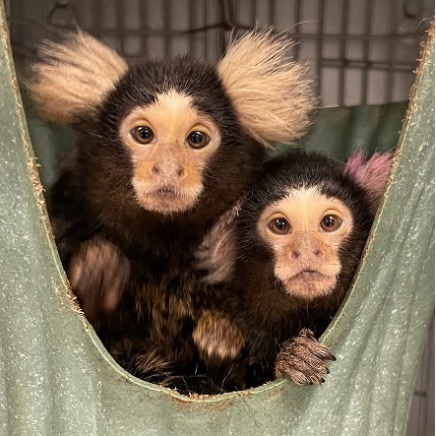
A pair of common marmosets living at Johns Hopkins University
What is involved in creating and using playbacks?
Creating and using playbacks does have some associated equipment and time costs, and requires some technical expertise. As such, it would be great if primatologists interested in using playbacks with the same species could share recordings across institutions when appropriate. This is why our project aimed to assess how captive common marmosets respond to affiliative vocalizations from unknown individuals. If affiliative vocalizations from unknown callers aren’t aversive, then we can share recordings from different populations so that more people can make use of playbacks.
If working independently, you will first want to invest in a handheld recorder and directional microphone (e.g., a Zoom Handy Recorder and a Sennheiser shotgun mic). Then, you’ll spend a good portion of time with the animals recording many of the target vocalizations to use for later playback. Recording more calls than you think is necessary is a good practice, as some of the calls will not be usable due to background noise, overlapping animal vocalizations, etc. We know common marmosets respond differently to manipulated vocalization recordings (Osmanski & Wang, 2023), so getting good quality recordings is important. Then, you’ll use audio editing software (some of which are free, e.g., Praat and Audacity) to create the playback stimuli, which is a single audio file with multiple vocalizations that were recorded at different times, for example. Finally, you’ll need a good directional speaker to play back the audio file you created to the animals. For more information on audio recording and playback methods with primates, see Fischer, Noser, & Hammerschmidt, 2013.
What sparked your team’s interest in this project?
I studied gelada and white-faced capuchin vocalizations in graduate school, and now that I’m working with animal behavior in an applied setting, I’m thinking about vocalizations as a tool to assess, and potentially improve, captive primate welfare. Knowing my interest in vocalizations, my colleague, Dr. Lydia Hopper, shared Dr. Claire Watson’s dissertation work with me. Watson and Caldwell (2010) found that, when neighboring animals were calling with an affiliate “chirp” vocalization (https://www.marmosetcare.stir.ac.uk/understanding-behaviour/calls.html) at higher rates, captive common marmosets spent more time affiliating with their own partners. This finding suggested that the positive, affiliative states communicated through these calls might be “contagious” and could possibly be promoted by playbacks of chirps. Dr. Watson tested this with 5-minute playbacks of chirps at high rates and found that marmosets were more likely to affiliate immediately after the playback of a chirp call than immediately before. On days when chirps were played back for multiple hours, marmosets spent more time affiliating even after the playbacks stopped (Watson, Buchanan-Smith, & Caldwell, 2014).
We found these results very exciting – if playbacks of friendly vocalizations can promote affiliation, they could be used during social introductions to improve the chances of new pairs bonding, during husbandry activities to encourage primates to seek social support to better cope with stressors, or even as a potential comfort to singly housed primates. So, my team (Scout Clair, Behavioral Management Technologist, Rachel Choo, undergraduate research assistant, and myself) set out to replicate these results with the Johns Hopkins common marmoset colony.
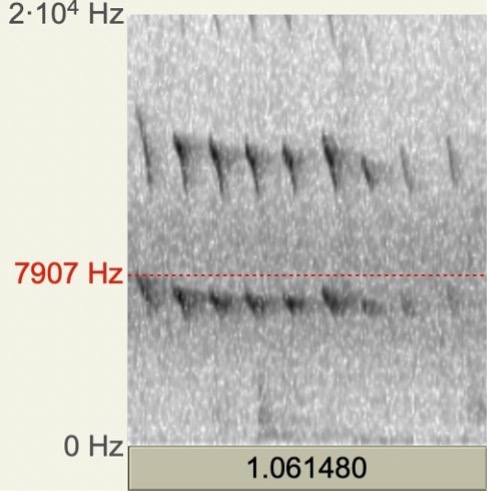
This is a spectrogram of a chirp bout visualized in Praat software. Time in seconds is along the x- axis, sound frequency in hertz is along the y-axis, and the darker more saturated parts of the image indicate greater amplitude. To the untrained human ear, chirps sound similar to another marmoset vocalization, so we used spectrogram parameters to confirm recorded vocalizations were chirps. Chirps start around 8,000 Hz and quickly drop in frequency ending around 5,000 Hz, visualized as a brief call with a slight downward slant to the right.
How did you conduct your study, and what did you find?
For this project, we studied six male, pair-housed marmosets. They each experienced two playbacks – one with chirps recorded in their own colony room so they would be familiar with the callers, and the other with chirps recorded in a completely separate facility so the callers would be unfamiliar. In the five minutes before, during, and after the playbacks, we recorded all instances of affiliative behavior and anxiety-related behavior (such as scent marking and scratching), and we recorded activity level (resting, alert, traveling, engaging with something in the enclosure) every 15 seconds.
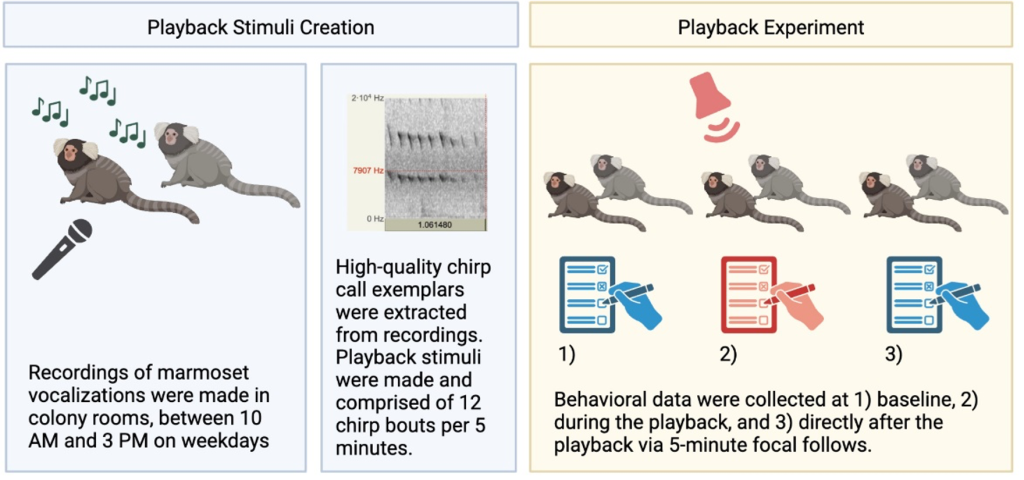
This infographic outlines our methods for creating the playback stimuli and running the playback experiments.
Once experiments were complete, we compared rates of these behaviors across the three timepoints, predicting that we would see more affiliative behavior in the 5 minutes during and after the chirp playback than in the 5 minutes before the playback started. However, we found no differences in either behavior category, nor in activity level, across the three timepoints. Similarly, there were no differences in behavior between the unfamiliar caller condition and the familiar caller condition.
What are the implications of these results?
Though we did not find evidence of the chirp playbacks increasing affiliation in the pairs of marmosets we studied, we were encouraged that our marmosets did not respond negatively to the chirps. We are interested in conducting these experiments with more subjects (our six males were relatively young, and only some were male-female pairs while others were male-male sibling pairs), and with longer playbacks to determine if behavioral changes arise with higher exposure to the affiliative calls. If future studies do indicate benefits of chirp playbacks, and our finding that marmosets don’t respond negatively to chirps from unfamiliar callers is replicated, this would suggest we could share chirp playback stimuli across institutions, making playbacks feasible for more colonies to try out.
How did the ASP Melinda Novak Welfare Grant help this study?
With the support of the ASP Melinda Novak Welfare Grant, we were able to purchase the recording equipment and speaker system required to conduct this study. Through my previous work, I was familiar with how to get good quality audio recordings and conduct playbacks, but we didn’t have access to the tools. Now, we have everything we need to conduct additional experiments and, depending on those results, use playbacks as auditory enrichment in the future.
What future directions do you see for evaluating playbacks as a behavioral management tool?
There is very little information about using playbacks to promote captive primate welfare, so there are many possible future directions. Most notably, playbacks need to be tested with other species! We piloted our methods with a few cynomolgus macaques, playing them familiar callers’ “coo” vocalizations (see https://macaques.nc3rs.org.uk/about-macaques/behaviour for examples), and they often responded with coos of their own, suggesting they at least perceived the playbacks to be genuine calls. So, we have common marmoset chirps and cynomolgus macaque coos recorded that we would be happy to share with anyone interested in testing them out.
We’ve heard that other institutions are trying affiliative call playbacks during social introductions to test whether they improve pairing success. This is the type of application we’re most excited about. If you’re using playbacks as enrichment or to promote captive primate welfare in any way, we’d love to hear about it! You can reach us at RARbehavior@live.johnshopkins.edu