
The ASP “Keep ‘Em Wild” Campaign to End the Primate Pet Trade in the United States
The American Society of Primatologists (ASP) Conservation Committee’s “Keep ‘Em Wild” campaign supports the Captive Primate Safety Act (CPSA) of 2025 and is using other strategies to end the primate pet trade in the United States. Here, ASP members Marilyn Norconk, Sylvia Atsalis, Anne Savage, Katie Gerstner, and Carla Rojas, explain the primate pet trade and its extensive impacts on the lives of primates.
What is the history of the primate pet trade in the U.S.? By the mid-19th century in the U.S., dogs, cats, birds and small mammals were commonly kept as pets, but primates remained unusual and were not part of mainstream pet ownership (Grier, 2010). One of the earliest documented examples of pet monkeys in the United States comes from nineteenth-century San Francisco, where monkeys brought back on ships from Central America were kept in private homes and displayed as attractions (Conrad, 2022).
Although the modern U.S. primate pet trade is relatively recent, humans have kept captive primates for thousands of years. Ancient Egyptian art and funerary objects often depict sacred baboons (Dominy, 2021), and by the eighteenth-century pet monkeys were fashionable among wealthy Europeans (as depicted in Infanta Isabel Clara Eugenia and Magdalena Ruiz by artist Alonso Sánchez Coello). In some Indigenous communities, people formed close bonds with orphaned primates, integrating them as close companions in their lives (Alexander et al., 2023). These examples, however, differ from today’s highly commercialized private ownership and trade (Be the Voice. Help Eliminate the Primate Pet Trade in the U.S.). What began as occasional ownership of individual monkeys has evolved into a highly lucrative market supported by global illegal importation, specialized breeders, and social media. Unfortunately, the U.S. now has one of the largest and most active markets for pet primates in the world (AZA, IFAW, WWF, 2026).
How many primates are estimated to be kept as pets in the U.S., and which species are commonly kept as pets? The second part of the question is easier to answer than the first part. International demand is primarily for small-bodied primates that can be concealed in luggage or carry-on bags. Mortality rates are high. Marmosets, lemurs, capuchins, and squirrel monkeys were the top four species most often encountered for sale in the U.S. using six online, publicly accessible websites by Seaboch and Cahoon (2021). Another recent publication using four social media platforms found a similar ranking of primates offered for sale, apart from macaques that ranked #1 in this study (AZA, IFAW, WWF, 2026). These are estimates based on advertisements and on-line offers, not actual sales. Theoretically, a reliable count could be obtained based on the number of permits granted in states that require them (see #5, below) but, to our knowledge, that has not been done. This is a round-about answer to confess that we don’t know how many primates are living in private homes in the U.S. An estimate of “15,000” appears repeatedly in publications (e.g., Seaboch and Cahoon, 2021) without a reference for the information, and the number has not changed for years. Nevertheless, several studies reveal an active and substantial market for primates (Norconk et al., 2020), and no one suggests that demand is declining (e.g., Badihi et al., 2024).
What are the physical and psychological impacts to primates when they live with people as pets? The typical primate pet is an infant, recently weaned and probably hand reared. Knowing that primates follow a relatively long and intensive developmental period, removal from the mother and human handling alters normal behavior for life and permanently disrupts species-typical psychological and social development. Many develop health problems because it is extremely difficult to meet their specialized nutritional needs, provide enough exercise and cognitive stimulation, and ensure appropriate veterinary care. Providing inanimate objects (toys) and human contact are not substitutes for social and intellectual stimulation of natural group living. Like many animals kept in inappropriate conditions, primates may become aggressive. Keeping primates as pets is therefore both a serious animal welfare issue and a public safety concern.
What trade chain drives the primate pet trade in the U.S., and what are the welfare impacts to primates at each step of it? Primates sold as pets in the U.S. come from one of three sources. First, wild-caught primates can be moved across international borders, often in abysmal conditions (see Shanee et al., 2017; Garber et al., 2024). If they do not have an export permit from the country of origin, they are being transferred illegally. The illegal traffic in infant Mexican spider monkeys across the southern border of the U.S. is particularly problematic, endangering the infants and resulting in the possible loss of group members during capture in Mexico.
Second, countries such as South Africa have become breeding hubs for the legal trade in non-native primate species [particularly common marmosets (> 15,000 from 1991-2022), tamarins, squirrel monkeys and capuchins] (Shivambu et al., 2024). The U.S. was the top importer of mammals bred in South Africa (although it was not clear how many were exported as pets and how many as research animals) (Shivambu et al., 2024).
Third, legal and illegal captive breeding and hand rearing of primates at breeding facilities in the U.S. provides a ready pool of primates (particularly infants) for sale and exchange on the private market.
The demand for primate pets continues to grow as social media platforms provide rapid and widespread advertisements of their availability (Collins and Campera, 2024; Nijman et al., 2021). Strong et al. (2025) found that 45.5% of TikTok videos of primates were taken in private homes and suggested that countering those videos with images of primates in their natural habitats, zoos or sanctuaries could help discourage ownership of primate pets (the stimulus for ASP’s Keep ‘Em Wild campaign).
Are there currently any laws that oversee the primate pet trade in the U.S.? Yes, there are several federal and state laws designed to protect primates in the U.S. CITES (the Convention on International Trade in Endangered Species) provides guidance based on the species vulnerability in its native habitat. Using the structure provided by the IUCN (International Union for the Conservation of Nature), endangered and critically endangered primates are on CITES Appendix I (cannot be imported, but with some exceptions); all other primates are on Appendix II (may be imported with a permit from the exporting country). The Endangered Species Act of 1973 provides the legal basis for administering CITES criteria in the U.S.; the federal Fish and Wildlife Service (FWS) enforces the act, e.g., confiscations at a border crossing and follow-up care (Norconk et al., 2024).
The Lacey Act of 1981 is the most substantive federal law that deals with the movement and transfer of illegally acquired animals, internationally and between states. The original intention of the Lacey Act was to protect vulnerable species (particularly game birds) from over-exploitation. It has morphed into broader prohibitions for the breeding and movement of specific animals and plants. A recent amendment to the Lacey Act, the Big Cat Public Safety Act of 2022, prohibits any individual in the U.S. from possessing, breeding, importing and moving any “big” cat across state or international borders. It, too, is enforced by FWS. The Captive Primate Safety Act, currently in Congress, would similarly amend the Lacey Act and extend protections to all primates. Specifically, it would prohibit the breeding or transfer of any nonhuman primate across international or state lines, effectively banning the primate pet trade, with exceptions especially for primates housed in USDA-licensed facilities.
In the U.S., state laws have the most immediate impact on the ownership and private possession of primates. Twenty-one states ban the commercial trade and private ownership of non-human primates; 11 states do not ban primate pets; and 18 states have various permitting processes or may allow for the private possession of some species but not others. We were surprised that possessing a chimpanzee or gorilla was permitted, often with restrictions, in 13 states (Great Ape Laws by State | Animal Legal & Historical Center) as of 2013. Even in states that ban the possession of primates by private owners, the laws contain many loopholes. For example, in Alaska, great apes are classified as game animals and are prohibited unless the owner obtains a permit from the Department of Fish and Game. Similar laws are found in Arizona, South Dakota and Minnesota. The CPSA would close many existing loopholes.
If passed into law, how would the Captive Primate Safety Act end the primate pet trade in the U.S., and what would happen to primates already living as pets and to those held in the trade chain? Good question! According to the text of the bill (Text – S.4206 – 118th Congress (2023-2024): Captive Primate Safety Act), if the primate pet was born before the CPSA is enacted, the owner must register the animal within 180 days of the bill’s passage, may not breed or sell the pet, and may not engage in direct contact of the animal with the public. Specific actions to implement and enforce regulations must be made within 6 months of the bill’s passage by the Secretary of the Interior. Currently, there are no procedures for giving up a primate pet in the U.S., but the American Zoological Association and the U.S. Fish and Wildlife Service has created the Wildlife Confiscations Network and introduced a bill in congress (H.R.3538, Wildlife Confiscations Network Act) that would help coordinate the care and placement of confiscated wildlife, including primates. The recent case of a marmoset being abandoned on a bus in London (Monkey abandoned in laundry bag on London bus) has been attributed to the passage of a law similar to the CPSA in the UK requiring that primate pet owners obtain a permit. If the CPSA passes, the issue of how to surrender a primate pet will become more urgent in the U.S.
What are the barriers to getting the Captive Primate Safety Act passed into law? Unfortunately, there are multiple barriers. The most significant barrier is competing congressional priorities. TheCaptive Primate SafetyAct has been introduced across multiple Congresses, but it has repeatedly stalled before reaching a committee hearing or floor vote. There are always legislative priorities that cover sweeping national issues and compete for calendar time, such as immigration, national security, healthcare, and tax policy.
Another barrier is the lack of sustained public pressure to eliminate the trade in pet primates. While polling shows 54% of Americans strongly or somewhat oppose keeping primates as pets (US polling data on protecting animals and nature ), very few people actively express their views to their elected officials. This lack of sustained constituent pressure gives lawmakers little political incentive to prioritize the bill. Others are actively working against the passage of the bill, e.g., some exotic animal breeders, private primate owners, animal exhibitors, and wildlife dealers. They argue that animal regulation should remain a state matter, that responsible owners should not be penalized for the actions of irresponsible ones, and that existing laws are sufficient if properly enforced. One reason this debate persists is that state laws vary widely, as mentioned above. However, because primates easily cross state lines during private sales, supporters of the CPSA argue a federal standard is necessary to close interstate commerce loopholes.
Finally, misconceptions persist about what the bill would do. Some believe it would permit confiscation of existing pets, ban legitimate conservation breeding, or close accredited zoos. However, the bill targets future private commercial trade and ownership of nonhuman primates. It explicitly exempts qualified research and AZA-accredited facilities and grandfathers in current owners with some restrictions.
What other strategies is the Keep ‘Em Wild campaign using to help end the primate pet trade? The goal of the campaign was not only to educate on the dangers of the primate pet trade using several social media platforms and the ASP website, but also to advocate for the passage of the Captive Primate Safety Act. The good news is that as of the end of July 2026, H.R. 3199 has bipartisan support and 49 co-sponsors. The bill will need to be voted out of the Natural Resources Committee before the House can vote on it. The more committee members who have signed onto the bill, and are aware of the benefits of passing it, the more likely they are to vote for it. Go to Meet Our Members | House Committee on Natural Resources to see if your representative is on the committee and write to them about the importance of bringing this legislation to a vote in the House. Our “how to” video guide will help you to prepare some text to congressional representatives and senators (Primates are not pets. Help pass the Captive Primate Safety Act.).
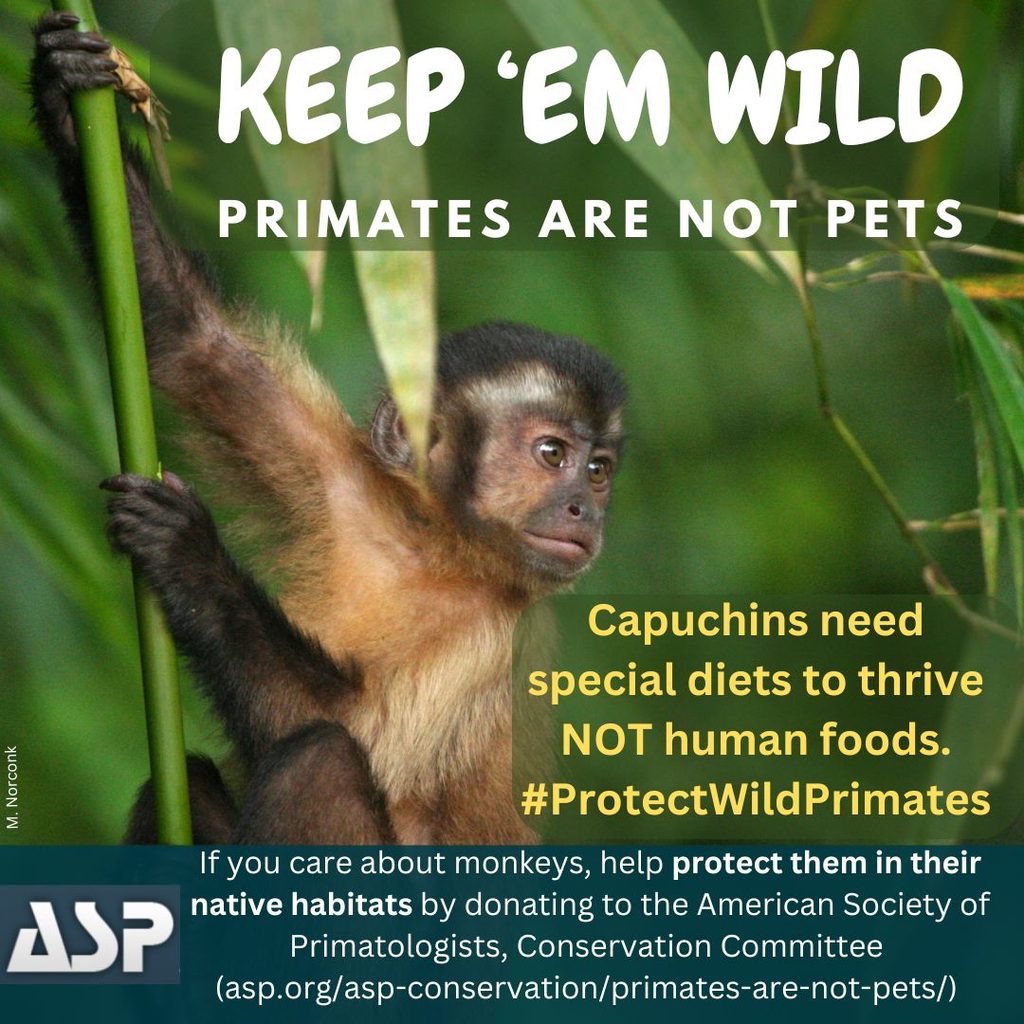
The ASP Keep ‘Em Wild Campaign outreach campaign included social media posts and informational videos. The YouTube videos were created by ASP member Carla Rojas. ASP member Katie Gerstner designed many of the social media posts for the Keep ‘Em Wild campaign.
Of the following members of the Environment and Public Works Committee in the U.S. Senate, only four (in bold-faced type) have signed onto the bill (S.1594) [Shelly Moore Capito (WV), chair; Kevin Cramer (ND); Cynthia Lumis (WY); John Curtis (UT); Dan Sullivan (AK); Pete Ricketts (NE); Roger Wickler (MS); John Boozman (AR); Jon Husted (OH); Darline Graham (SC); Sheldon Whitehouse (RI); Bernie Sanders (VT); Jeff Merkley (OR); Edward Markey (MA); Mark Kelly (AZ); Alex Padilla (CA); Adam Schiff (CA); Lisa Blunt Rochester (DE); Angela Alsobrooks (MD)]. If you live in one of the states that lacks senatorial endorsement, please write to your senators and ask them to co-sponsor the bill.
As primatologists we understand that legislation alone is insufficient to protect primates. We must invest in education that changes public attitudes, focusing on responsible media portrayals. But just as important is fostering EMPATHY, especially in children. Humans see animals through their own lens, but true empathy means seeing the world through the eyes of the animal, in this case through the primate’s eyes. When we do, we realize that even the most caring owner cannot provide what a lemur, monkey or chimpanzee truly needs, which is the companionship of its own kind, the foods found in its natural environment and the freedom to live autonomously. We believe that effective education is more than facts. It’s about asking people to feel deeply for these wild animals and understand that their needs cannot be met in a human household, no matter how loving or well-intentioned it may be.
To support the ASP Keep ‘Em Wild campaign and primate conservation, please consider donating by clicking here
References
Alexander, S. D., Waters, S., Aldrich, B. C., Shanee, S., Clarke, T. A., Radford, L., Hansen, M.F., Gnanaolivu, S.D. & Dempsey, A. (2023). The past, present, and future of the primate pet trade. In T. McKinney et al. (Eds) Primates in anthropogenic landscapes: Exploring primate behavioural flexibility across human contexts (pp. 247-266). Cham: Springer International Publishing.
AZA, IFAW, WWF (2026). Primates for purchase: The surge in sales on social media in the U.S. Washington D.C. https://www.worldwildlife.org/publications/primates-for-purchase-the-surge-in-sales-on-social-media-in-the-us/
Badihi, G., Nielsen, D. R., Garber, P. A., Gill, M., Jones-Engel, L., Maldonado, A. M., Dore, K.M., Cramer, J.D., Lappan, S., Dolins, F., Sy, E.Y., Fuentes, A., Nijman, V. & Hansen, M. F. (2024). Perspectives on Conservation Impacts of the Global Primate Trade: G. Badihi et al. International Journal of Primatology, 45(4), 972-999. https://doi.org/10.1007/s10764-024-00431-9
BBC.com (2026). Monkey abandoned in laundry bag on London bus. (21 July 2026) https://www.bbc.com/news/articles/c70g8wez8r1o
Collins, D., & Campera, M. (2024). Investigating the extent and nature of the primate pet trade on TikTok. Conservation, 4(4), 547-559. https://doi.org/10.3390/conservation4040033
Conrad, C. (2022). The monkeys and parrots of gold-rush era California. Ethnobiology Letters 2022 13(1):20–26 https://doi.org/10.14237/ebl.13.1.2022.1758
Dominy, N. (2021). Secrets of the sacred baboons. Scientific American 325:46-53. https://www.jstor.org/stable/10.2307/27418194
Garber, P. A., Estrada, A., Shanee, S., Svensson, M. S., Verde Arregoitia, L., Nijman, V., Shanee, N., Gouveia, S. F., Nekaris, K. A. I., Chaudhary, A., Bicca-Marques, J. C., Hansen, M. F., et al. (2024). Global wildlife trade and trafficking contribute to the world’s nonhuman primate conservation crisis. Frontiers in Conservation Science, 5, 1400613. https://doi.org/10.3389/fcosc.2024.1400613
Grier, K. C. (2010). Pets in America: A history. UNC Press Books.
Nijman, V., Smith, J. H., Foreman, G., Campera, M., Feddema, K., & Nekaris, K. A. I. (2021). Monitoring the trade of legally protected wildlife on Facebook and Instagram illustrated by the advertising and sale of apes in Indonesia. Diversity, 13(6), 236. https://doi.org/10.3390/d13060236
Norconk, M. A., Atsalis, S., Tully, G., Santillán, A. M., Waters, S., Knott, C. D. Ross, S.R., Shanee, S., & Stiles, D. (2020). Reducing the primate pet trade: Actions for primatologists. American journal of primatology, 82(1), e23079. https://doi.org/10.1002/ajp.23079
Norconk, M. A., Atsalis, S., & Savage, A. (2024). Can we eliminate the primate pet trade in the United States? American Journal of Primatology, 86(3), e23525. https://doi.org/10.1002/ajp.23525
Nunes, V. F., Lopes, P. F., & Ferreira, R. G. (2023). #capuchin monkeys on social media: a threat for species conservation. Anthrozoös, 36(4), 665-683. https://doi.org/10.1080/08927936.2023.2210440
Seaboch, M. S., & Cahoon, S. N. (2021). Pet primates for sale in the United States. PLoS One, 16(9), e0256552. https://doi.org/10.1371/journal.pone.0256552
Shanee, N., Mendoza, A. P., & Shanee, S. (2017). Diagnostic overview of the illegal trade in primates and law enforcement in Peru. American Journal of Primatology, 79(11), https://doi.org/10.1002/ajp.22516
Shivambu, N., Shivambu, T. C., Nelufule, T., Moshobane, M. C., Seoraj-Pillai, N., & Nangammbi, T. C. (2024). South Africa as a Donor of Its Native and Exotic Species to the International Pet Trade. Sustainability, 16(20), 8828. https://doi.org/10.3390/su16208828
Strong, K. K., Frakes, L. A., Mayhew, J. A., Thompson, C. J., & Ratliff, C. P. (2025). Behind the trend: an examination of primate content on TikTok. American Journal of Primatology, 87(8), e70063. https://doi.org/10.1002/ajp.70063
The ASP “Hot Topics in Animal Welfare” are produced by the ASP Primate Care Committee. These quarterly posts showcase the work of ASP members who are working to enhance and refine primate welfare across settings, in captivity and the wild.