
A Decade of Hot Topics in Primate Welfare: Looking Back and Looking Forward
In the current Hot Topics in Primate Welfare feature, the American Society of Primatologists (ASP) Primate Care Committee summarizes seven themes that have emerged over the past decade of Hot Topics features in primate welfare.
For nearly ten years, the ASP Hot Topics in Primate Welfare posts have highlighted research, practices, and emerging approaches that shape how we understand and improve the welfare of nonhuman primates (NHPs). Since the first feature in 2016, Hot Topics has covered work conducted across laboratories, zoos, sanctuaries, rehabilitation centers, and wild populations. Across these features, one of the clearest trends is the changing definition and evaluation of primate welfare. The field has moved beyond simply identifying poor welfare or reducing negative outcomes toward a broader approach that includes individual differences, social relationships, physical health, positive experiences, choice, agency, and long-term quality of life.
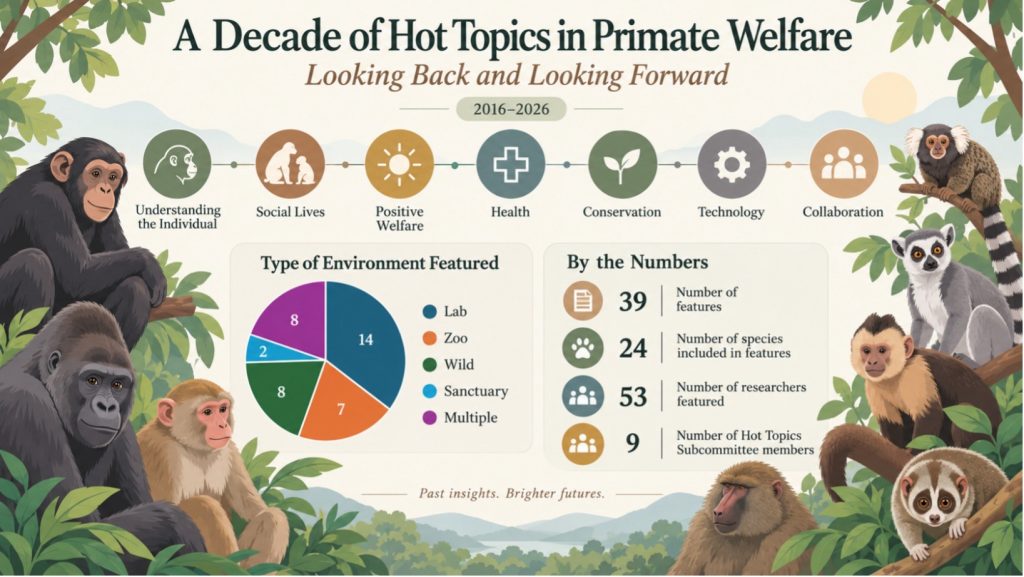
Image generated by ChatGPT. Content reviewed and verified by the ASP Primate Care Committee
Theme 1: From identifying poor welfare, to understanding the individual
Many of the earlier Hot Topics focused on an important and still challenging question: How do we know whether an individual primate is experiencing good welfare? Early features examined the use of temperament testing to inform management, the interpretation of abnormal or self-directed behaviors, and physiological measures of stress and allostatic load. This work emphasized that no single behavioral or physiological measure can fully capture welfare. Behaviors that appear abnormal may not always indicate poor welfare, and animals that show few obvious behavioral signs of distress may still experience physiological or social challenges. As a result, welfare assessment has increasingly relied on combining multiple measures and considering an animal’s history, temperament, social environment, health, and behavioral repertoire.
A focus on the individual has remained an important theme throughout the past decade. Recent Hot Topics have featured individualized care plans for sanctuary chimpanzees, physical therapy for animals experiencing age- or health-related mobility limitations, treatment of disruptive behaviors using functional analysis, and management approaches that account for differences in temperament or anxiety-related reactivity. This illustrates the recognition that species-typical needs are essential, but good welfare also requires attention to each individual’s health, preferences, behavioral history, social relationships, and response to the environment.
Theme 2: Social lives matter
The importance of social relationships has also been a consistent topic. NHPs are highly social animals, but simply placing animals together does not necessarily result in positive social welfare. Hot Topics has featured work that examined group size and composition in chimpanzees, social housing of slow lorises, management of large rhesus macaque groups, social network analysis, and the development of successful social groups in species that can present particular management challenges. This reflects a more detailed understanding of social welfare. Social housing includes questions of compatibility, relationship quality, dominance structure, opportunities for affiliation, the ability to avoid conflict, and the stability of the group, and how each of these can influence welfare. Social network analysis and other quantitative approaches allow researchers and caregivers to evaluate group relationships in ways that were difficult to measure previously. These methods help shift social management from a primarily logistical challenge toward a measurable and modifiable component of welfare.
Theme 3: Moving beyond the absence of poor welfare
Another major development over the past decade has been increasing attention to positive welfare. Historically, animal welfare programs often focused primarily on preventing or reducing negative experiences, such as stress, injury, illness, aggression, or abnormal behavior. These goals remain critical, but they represent only part of what constitutes good welfare. Across more recent Hot Topics, there is an increasing emphasis on enrichment, engagement, learning, preference, choice, and agency. Features have examined bedding and other enrichment strategies, touchscreen systems, playback of conspecific vocalizations, behavioral management programs, and positive reinforcement training. Positive reinforcement training can reduce stress associated with routine husbandry or research procedures, as well as provide opportunities for animals to participate voluntarily in their own care, make choices, learn new behaviors, and interact predictably with caregivers.
This represents a broader change in how welfare is conceptualized. Increasingly, good welfare is understood to include opportunities to engage with the environment, maintain meaningful social relationships, exercise control, solve problems, and experience positive events. As such, choice and agency become important welfare outcomes rather than optional additions to NHP care.
Theme 4: Welfare is also health
Hot Topics features have also highlighted the close relationship between behavioral welfare and physical health. Features over the past decade have addressed wasting syndrome in marmosets, cardiovascular health through the Great Ape Heart Project, microbiome biology, nutrition, energy expenditure, physical therapy, and non-invasive physiological biomarkers. These topics emphasize that physical and psychological welfare cannot easily be separated.
Changes in behavior can be early indicators of disease or discomfort, while chronic health conditions can alter activity, social interaction, cognition, and engagement with the environment. Conversely, social conditions, stress, diet, activity, and enrichment can influence physiological health. This relationship becomes particularly important as primates in managed care live longer. Aging populations may require increasingly individualized approaches to mobility, nutrition, cardiovascular health, cognition, social management, and other age-related changes. Integrating veterinary care with behavioral and welfare assessment will therefore remain an important direction for the field.
Theme 5: Connecting welfare and conservation
Another notable theme is the expanding connection between welfare and conservation. Hot Topics has included work on wild and free-ranging primates affected by snares, electrical infrastructure, tourism, habitat disturbance, trafficking, and other human activities. Features have also highlighted non-invasive biomarkers and other methods that can be used to evaluate the physiological consequences of environmental change in wild populations. This work reinforces the idea that conservation and welfare are related but distinct considerations. Conservation traditionally focuses on populations, species, and long-term persistence, while welfare often focuses on the experiences of individual animals. In practice, many anthropogenic threats affect both. A population may remain viable while individual animals experience injury, chronic stress, nutritional challenges, or disrupted social relationships. Incorporating welfare measures into conservation research can therefore provide a more complete understanding of how environmental and human pressures affect primates.
At the same time, methods developed in managed settings can contribute to conservation. Behavioral assessment, veterinary techniques, physiological monitoring, non-invasive sampling, and automated data collection may all have applications in the field. Likewise, knowledge of natural ecology and behavior remains fundamental for developing appropriate housing, enrichment, social management, and husbandry practices for primates in human care. The exchange of information between captive and field research has therefore become increasingly important.
Theme 6: New tools for an old question
Technological advances are also changing how primate welfare can be studied. Earlier Hot Topics relied primarily on traditional behavioral observation, physiological sampling, and husbandry interventions. More recent features have included touchscreens, microbiome analysis, social network analysis, non-invasive biomarkers, automated monitoring, computer vision, and artificial intelligence. These tools create opportunities to collect more detailed information about NHP behavior and health. Automated monitoring may detect changes in activity, movement, or social interaction outside normal observation periods. Computer vision and artificial intelligence may eventually help identify subtle behavioral changes that precede obvious clinical or welfare concerns. Touchscreen systems can simultaneously support cognitive research and provide enrichment. Biomarkers can complement behavioral observations by providing additional information about physiological state.
However, technology is most useful when it complements rather than replaces careful behavioral observation and knowledge of individual animals. One of the lessons from the past decade is that welfare is multidimensional. The benefit of emerging technologies may therefore come from combining behavioral, physiological, social, environmental, and health data to develop a more complete picture of an individual’s welfare over time.
Theme 7: Welfare through collaboration
A final theme across Hot Topics is the importance of collaboration. Improving primate welfare requires input from animal care staff, behaviorists, veterinarians, researchers, nutritionists, conservationists, data scientists, and others. Recent features have highlighted this directly, including the collaboration between the American Society of Primatologists and the Association of Primate Veterinarians. PCC programs such as the ASP Primate Welfare Awards and the Melinda Novak Primate Welfare Grant have also supported researchers and animal care professionals developing practical approaches to welfare questions.
Many important welfare improvements begin with observations made by people who work closely with animals every day. Collaboration allows those observations to become research questions, and research findings to become changes in husbandry, veterinary care, social management, or environmental enrichment. Maintaining strong connections between research and daily animal care will remain essential for continued progress.
What will the next ten years bring?
Looking across nearly ten years of Hot Topics, the questions being asked about primate welfare have clearly expanded. We still need to understand and reduce stress, illness, injury, aggression, and behavioral disturbance. At the same time, the field is increasingly asking what animals prefer, whether they have meaningful choices, whether their social relationships are successful, whether they can participate voluntarily in their care, and whether their environments provide opportunities for learning, exploration, and positive experiences.
The tools available to answer these questions are becoming more sophisticated. Automated behavioral monitoring, artificial intelligence, non-invasive biomarkers, cognitive testing, and longitudinal health data may allow changes in welfare to be detected earlier and evaluated with greater precision. Yet the past decade of Hot Topics also demonstrates that some of the most meaningful advances continue to come from careful observation, attention to individual animals, creative husbandry, and collaboration among the people who know them best.
As Hot Topics in Primate Welfare enters its next decade, the field is asking: What does good welfare look like for a primate, and how can we provide each individual with the opportunity to experience it?
Brought to you by the ASP Primate Care Committee
These Hot Topics in Primate Welfare are led by the ASP Primate Care Committee (PCC), which plays an important role in advancing primate welfare through the development, coordination, and promotion of initiatives that support evidence-based practices and foster collaboration across the primatological community. The PCC consists of professionals from diverse backgrounds and across settings who work to facilitate the exchange of knowledge and best practices and to recognize innovative approaches to improving primate care. Among its many initiatives, the PCC organizes educational workshops that are held prior to most ASP meetings (i.e., pre-conference workshops), conference symposia related to welfare topics, supports professional development and training resources, and promotes welfare-focused research and innovation through the ASP Primate Welfare Award and the Melinda Novak Primate Welfare Grant. The PCC encourages individuals from all areas of primatology to get involved! If you are interested in joining the PCC and contributing to these efforts, please e-mail pcc@asp.org.
The ASP “Hot Topics in Animal Welfare” are produced by the ASP Primate Care Committee. These quarterly posts showcase the work of ASP members who are working to enhance and refine primate welfare across settings, in captivity and the wild.